Saturday, December 11, 2010

Our new life in the village

After a week and a half in the backpacker mecca of Kathmandu- where restaurants overflow with pizzas, burgers and iodine-soaked (ie: SAFE) veggies, we knew we were in for a lifestyle change when we got out of the jeep in our new village homeland. Putali Bajar, literally ‘butterfly market’ is a 20-minute ride via a dilapidated 3-wheeled tin box (almost resembling a vehicle) to the ‘bustling’ city of Hetauda. One of the bigger cities in all of Nepal, Hetauda consists of about 4 paved roads intersecting at a statue of the Buddha. To our great surprise and utter glee, there is one shop in town that sells toilet paper and peanut butter.

Despite the lack of Western comforts, we have genuinely grown to love the slower pace of life, the friendly faces, the strong sense of community in our village of Putali Bajar—and we're starting to feel like we are live inside a fairy-tale land.


Our village marks the exact dividing line in Nepal where the epic mountains of the north meet the plains and jungles of the south. We get to enjoy the best of both worlds from the rooftop of our home shown above. 
75 degrees by day and 45 by night, the early morning mist shrouding our farmland merits the 5AM wake up call... (now and then)
Our shower, laundry mat, dishwasher, sink, bathroom
the flapping prayer flags of Kathmandu are now replaced by something equally holy... our first round of clean clothing!
Avi picks a papaya, one of the many crops found in our backyard jungle/farm (including, but not limited to: coconuts, pineapple, guava, mango, ginger, avocado, pomegranate, coffee beans, garlic, lichee, paan, turmeric, oranges, lemons, bananas, assorted berries, broccoli, cauliflower, spinach, radishes, potatoes, yams, mustard greens, onions, thyme, coriander, medicinal tea, peas, kidney beans, soy beans, wheat, rice and cotton). We are not joking. 
We're not the only farmers in town- most people in our village subsist off their own land
Signs of a modernizing world- many villagers have built brick or concrete houses next door to the mud/straw houses in which they were raised 
Our daily commute to the center of town
Where you can find a vegetable market, a handful of shops and this restaurant.
We are fortunate to have a local cyber cafe- but it is difficult to get online when you only have electricity 6 hours/day!
Vibrant colors paint the village sky over a roadside food stand
Front cover of the next sci-fi meets spooky-halloween-in-the-village blockbuster?
Cassie out for a stroll by the light of the moon
Mystical Putali Bajar

Easier said than done.

It may only be 50 miles from the ‘Big City’ of Kathmandu to the rural village where we have been be teaching, but a vehicle can only move so quickly when it is headed directly through the Himalayas— on roads comprised of rocks and boulders of varying shapes and sizes. Due to road conditions (or the lack there of…), herds of goats and buffalo, broken down jeeps, and buses that appear to have been constructed 600 years ago, traveling ANYWHERE in Nepal is easier said than done. Here are some views from the hills throughout our 5-hour bumpy jeep ride to Hetauda.

Minutes after leaving the jeep station in Kathmandu, the pavement ends... 
Before you could say Kathmandu 10 times, we were high up in foothills 
We were beginning to wonder what Nepali tires are made of... 

In the hills, people survive because of terrace farming techniques 
Many homes are supported by bamboo posts and rest precariously on the mountainside 
Rivers snake through the valleys 
Just when our ears were starting to pop, we were humbled by the snow-capped Himalayas towering in the near distance 
And as we felt that we were continually staring death in the face, we were once again humbled by the massive quantities of Nepalis atop the speeding rickety buses  
We stopped in a peaceful village to stretch our legs and use the facilities  
Maybe next time I'll hold it in.... (please enlarge to see Cassie's face) 
Wasn't so bad for the men 
Finally some smooth pavement to sooth our insides as we neared our destination 

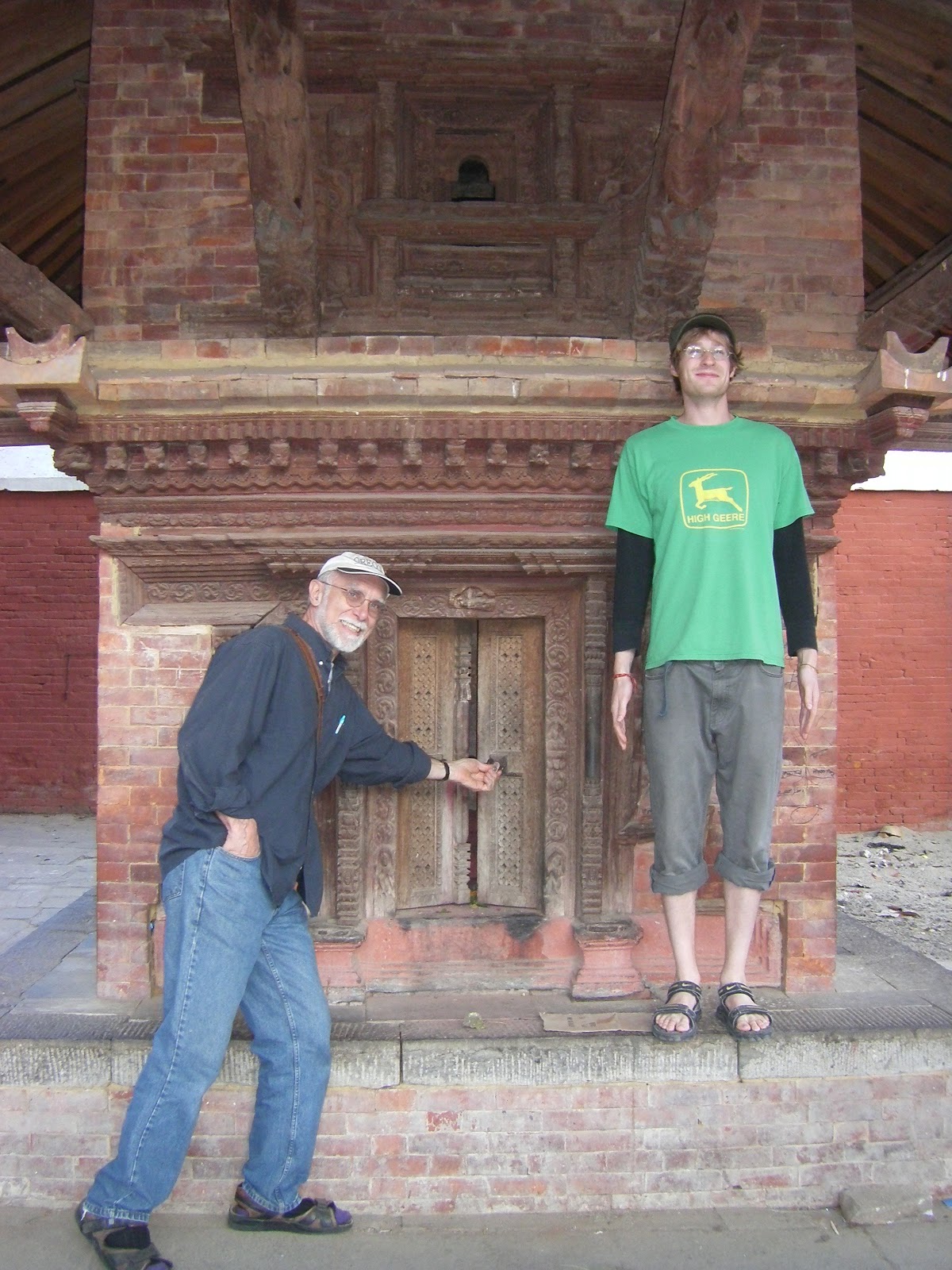
Were people ever really this short?!?


Are you sure that is where our heads are supposed to go? 


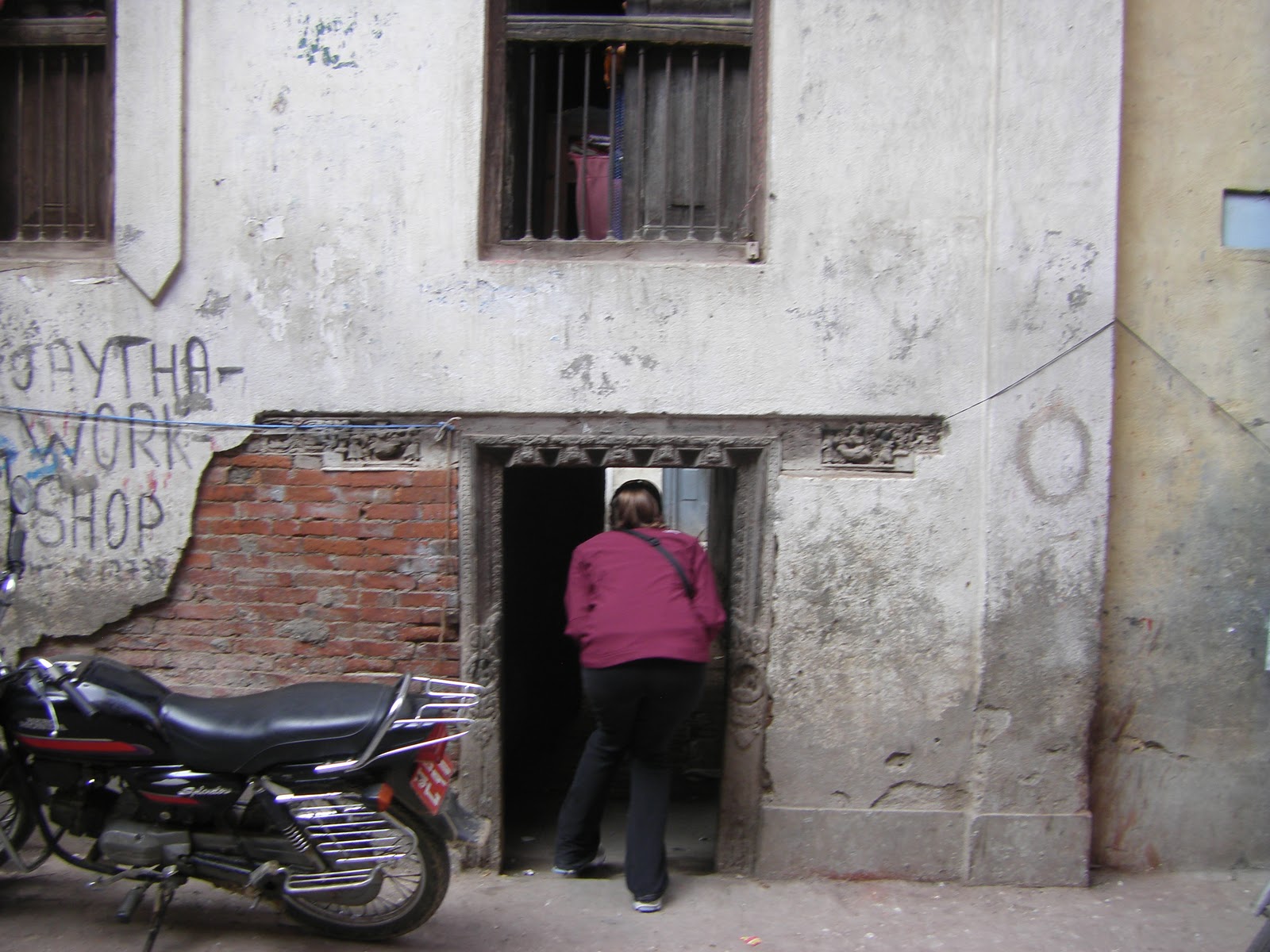
Historically, the Kathmandu Valley was the homeland of the Newari people and today much of the Nepali food, architecture and culture stems back to the Newars.  The Newars are famed throughout Asia for their farming techniques, skilled artists and distinct architecture.  Unfortunately for Avi’s head, one of the most distinguishing characteristics of Newari architecture is the ‘hobbit-sized’ doorway.  Among our favorite low doorway pictures, we’ve also included a few of our favorite walls that we’ve stumbled upon throughout the past two months (some of which feature normal sized doorways)

Avi's back is starting to hurt....
Yes, there are several people working in there. And no, that is not an extra large motorcycle
Another close call... catastrophe avoided!
At a towering 5'6'' even Cassie has to bend her knees to enter this restaurant
No, that isn't a window. Were the guards in this watchtower in front of the palace really going to protect the king? Or would they get stuck in the doorway leaving the watchtower? Guess we'll never know....
Is a chocolate bar really worth another lump on my head? The choices we have to make each day...

Normal sized doorways do exist in some regions:


First Impressions of Nepal


Exiting the Kathmandu airport

A sigh of relief overcame us as we left behind the crowds of India and found ourselves breathing fresh Himalayan air in Nepal. We spent our first week on the outskirts of Kathmandu, in Boudha— surrounded by dancing prayer flags, monks, pilgrims and authentic Tibetan Buddhist culture. These photos sum up our first impressions!

Watchful eyes of the Buddha reside over the town of Boudha 


Thousands of pilgrims circle the enormous Bodhnath Stupa every night to spin prayer wheels and send out peace to the world


A view of town from the Stupa 
Many Nepalis worship gods of all religions.  Check out the variety of deities for sale at this shop 
A typical sight in the Kathmandu Valley
Even monkeys spend their days chillin' with the Buddha
A view of Kathmandu from a hill-top temple 
Prayer flags adorn almost every mountain side
Famous Durbar Square in Kathmandu
A giant tree grows out of a shrine
Old world meets new: in a quickly modernizing city, deities are intertwined with iphones   
Om Mane Padme Hum
Just in case you didn't believe we were actually here.